Friday, October 29, 2010

Flashing


I have taken a break this week from working on my house full time to earn some money for a trailer. Ironically, the work that found me is replacing siding on an old victorian house. The house is being repainted and I am replacing the broken or split clapboards. It is interesting to see which claps are broken or rotten and what the cause was. I am learning some lessons by observing the work of the craftsmen from 120 years ago. It is amazing to see how improper repair jobs from relatively recent times have caused premature rot, and how most of the original siding is still in good condition. Seeing this is definitely incentive to try to do things properly on my house.

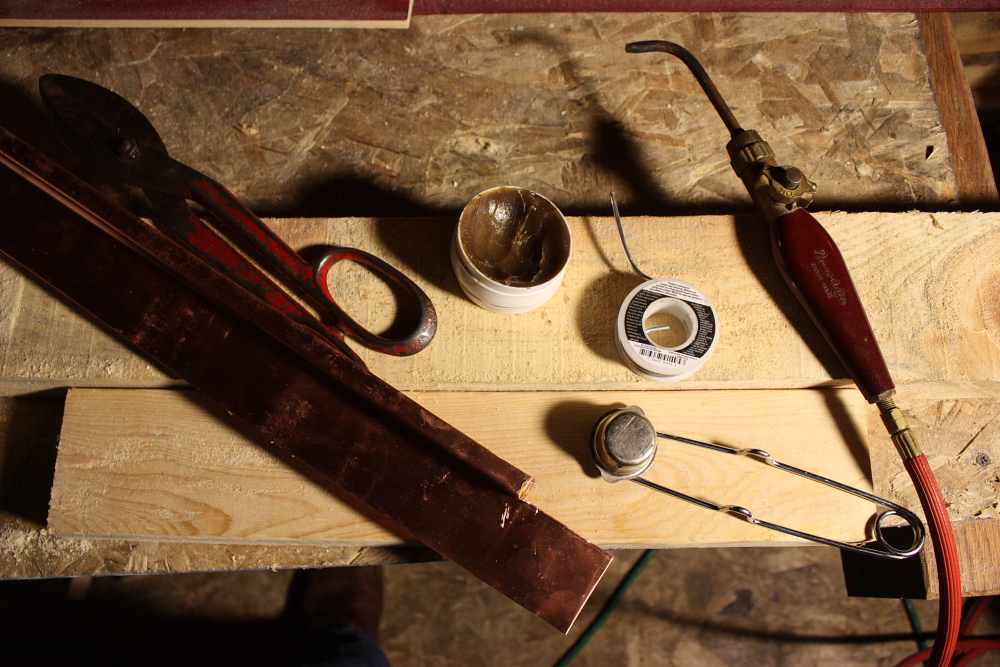
In the meantime, I did install some siding on my house in the evenings and I finished making my flashing. Here are some photos of manufacturing the copper flashing for the tops of the windows and door.


Wednesday, October 20, 2010

I went out this morning to check out a...
trailer
...but came home with a
new stove!
The trailer could work, but would need more work than I would like to do to make it suitable. It is about 35 feet long, and only 6'6" wide. The length is not a problem as it is easy to cut shorter, but it would take some time to make it wider. On the positive side, it does have very strong axles and electric brakes. This might be my best option if I don't find something else soon.

The stove however, is perfect. It is slightly smaller than the other one I was planning on using but should still be more than adequate to heat the space. Saving space in this house is the key to making it work. The stove is made by Morso in Denmark. It is designed to burn coal or wood and seems to be made very well. My favorite thing about it though is the red enameled, pointy-eared squirrel cast into the side plates! I can't wait to be enjoying its warmth this winter (it is already getting cold)!

Tuesday, October 19, 2010

Et Cetera

Today with the help of Sarah again, the pile of siding on the sawhorses slowly moved onto the house. The East wall is sided to the top of the window, and the others are all sided to the bottoms of the windows. It is a slow but rewarding process to cut the siding, pare it for a perfect fit with a block plane, prime the ends and nail it in place. It is a job that begs one to stand back and appreciate the change every few courses.
Sarah taking a break
During our lunch break, I unexpectedly received a call from a reader of the blog who had seen a cheap trailer nearby that might work for my house. I am going to check it out tomorrow morning. Thanks Glen!

Here are a couple of quick shots of the progress.

Sunday, October 17, 2010

The siding begins

Soldered copper flashing
We had a very productive day on Friday! My friends Pat, Sarah and Steve helped me install the trim, flashing and some siding. Originally I had planned to have everything prepared so that the four of us could put up all of the siding on friday. Unfortunately I had more loose ends to tie up than I thought, and we didn't make it that far. I am very grateful for the help though, without it all of these little jobs would have taken me a long time to finish. In the last hour or so we finally got to the siding, and Pat and Steve nailed up about half of the East wall while Sarah cut the boards. It looks great!
Myself smashing my fingers while trying to drive small bronze nails

Pat finishing the door frame
Thank you Sarah for the pictures!

Wednesday, October 13, 2010


Yesterday I finally finished painting the last of my siding and trim with the help of a friend. There was a lot. Hopefully the time spent back-priming everything will pay off. It is nice to see it all painted and stacked waiting for installation.

Today I unrolled the roll of copper I found in the barn. I measured 42 feet of shiny 16 ounce copper. This is about half of what I need, but a major step in the right direction! I cut 6 inches off of the width of the roll for my flashing and the remaining 18 inch width will be used to form the standing seam roof pans. With the help of a sheet metal break loaned to me by a friend I have already started to form my flashing for the walls.

Tomorrow I have two friends coming to help me install the trim and siding. It will be an exciting day!

Sunday, October 10, 2010

Thoughts on the roof and skylight

With the trim and siding figured out (but not yet installed), I have been thinking a lot about my roof. The maximum legal height for a trailer without a special permit is thirteen feet and six inches. My house, sitting on a trailer thirty-two inches high, will be about twelve feet without the roof. Obviously my roof will need to be removable if I want to move my house without worrying about overhead wires or the law. My roof framing is made up of three rafter sets connected by purlins (see this post for a diagram) which will all be removable. The roof itself will consist of four bolt-on panels. Each one will have beaded pine board on the bottom side for my ceiling, 2x4 framing with insulation in the middle, followed by skip-plank sheathing and then standing seam copper on the outside. The construction of these panels will be straight forward, much like the roof panels I used to make when I worked for the timber frame company. My challenges will be making a removable ridge cap and a seam down the middle that will keep the rain out.

The only other detail that I need to figure out is the skylight. Originally I had wanted to build a raised unit that straddled the ridge as shown in this post. I am realizing that I need something simpler though. My dad sent me a link to the website for New England Skylights (NES), a company in Watertown, Massachusetts that builds beautiful copper windows. They do many new and restoration projects all over New England. The two photos below are of a window made by NES that is actually very similar to what I had envisioned having on my house.

http://www.newenglandskylights.com/projects.html

http://www.newenglandskylights.com/projects.html
Since my roof will be removable, I think I will simplify the window by limiting it to the South side only. The window in the picture below is a restoration done by NES which fits all of my parameters and looks incredible.

http://www.newenglandskylights.com/historical.html

I love the low profile of this window and how it fits so seamlessly into the standing seam roof. I am going to do everything I can to reproduce this. Ideally, I would make it so that it is hinged at the top to allow it to open. Time will tell if i can do this though.

Saturday, October 9, 2010

The wait for the weight is over


There is a set of questions that is almost always asked by newcomers to my project: "So you are going to live in this? Is there going to be a bathroom? When is it going to be finished? How much do you think it will weigh?" The fist two are easy. Yes and no, respectively. The next one I have stopped answering, but the fourth question now has an answer! This evening I finally sat down and computed the estimated weight. The measurements on the finished parts are accurate, and the estimates on the remaining sections are thorough. The grand total for the weight of my house, assuming my timber is fully dry, is about 4,500 pounds: less than I had originally though! This is what I expect it to weigh without a trailer, finished interior walls or the built-in furniture, all of which I have not fully planned out yet. My rough estimate for the finishing touches and furnishings is 1,500 pounds. If my trailer weighs 2,000 pounds, the entire system will be around 8,000 pounds which is still a reasonable weight for my truck to tow.

I am still looking for a suitable trailer. I would like something with a capacity of six to seven thousand pounds and a tare weight of 2,500 lbs or less. The frame must be 8' wide and at least 13' long, riding over the wheels. It doesn't need a deck though since my house can sit on the framing. If anyone comes across one for a reasonable price, please let me know!


I picked up the wood for my exterior trim on Thursday. I bought 1x4 and 1x6 D-Select Eastern White Pine. It is nice looking wood, but it was pricy. The small bundle of wood cost $240. By getting clear kiln-dried wood for everything exposed to the weather, I hope to avoid any repairs due to water damage for a long time. I have already back primed all the stock and as soon as it is dry I will start installing it!

Thursday, October 7, 2010

Cloaked in the miracles of science


After realizing how thin the siding actually is, I changed my plan to include some sheathing over the framing. This warranted another trip to see Larry for some 4/4" by 8" pine boards. He is raising his price by $0.05 to $0.35 a board foot- still a steal. It would have cost me twice as much to use plywood, and I would have had a lot of unusable waste since I have so many window and door openings. The sheathing went up smoothly; it was relaxing work for two rainy days.


I used Tyvek for my housewrap. Housewrap prevents wind from howling through the house, it keeps any stray water that makes it through the siding off of the framing and it allows moisture in the walls to make it outside. Traditionally, builder's felt has been used for this purpose. It is basically heavy paper that is impregnated with asphalt. It had been used for a long time and we know how it performs over time. I decided to use Tyvek because I had a partial roll kicking around. It performs the same function as felt paper but is more expensive since it is made with "The Miracles of Science" as proclaimed by DuPont over every square foot of the stuff. I did a little research and found that the benefits of Tyvek over felt paper are questionable. It is much lighter and easier to install, but the durability may be worse. Unfortunately I ran out of Tyvek with one more wrap to go and had to buy a new roll anyway. So much for saving money. It feels strange to have my house branded with a company's name. It looks like a DuPont Company Christmas present. This is the first mass produced material I have used so far (and possibly the only). It will be nice to cover this miracle of science with some good old clapboard siding.
After the Tyvek, I moved onto windows and doors. I built one window frame months ago which set the size of my steel casement windows. It took a morning with coffee and some graph paper to work out all of the nitty gritty details of the steel casements so that I could move onto the other windows. The small window on the North side of the house will have two swinging casements while the bigger window on the East side will have four of the same casements. Once I had all of this figured out I built the second frame. It was really enjoyable to be sitting at my bench chiseling mortices on another rainy day. It seems I do most of my work on rainy days- or maybe it just rains a lot in New England. 

I primed the sills and frames all the way around to hinder rot, then installed them for good, shimming the frames to within a sixteenth inch of square across the diagonals. The big salvaged window is also installed permanently so that the casements all swing freely without binding. Hopefully this doesn't change when I move the house. One last thing I did was to trim down a salvaged door frame from the Firehouse and install it. The difference between 100 year old wood and modern wood is incredible. This door frame is so perfectly straight, the grain is tight and it still weighs more than a modern production frame, even after over 100 years of service. Measuring in at 6'2" by 28", this will be a very small front door.

Next, I need to finish painting a couple of bundles of siding, install the exterior trim and hang the siding!


Thursday, September 2, 2010

A hand hewn beam

At least I stopped at hand hewing the timbers for my house. If I had tried to do that, this project would never be finished. This post is not directly related my little house, but it is a technique that could have been used to prepare my timbers in a more traditional way, so I  am going to write about it anyway.

Last week I took out a wall in our house to open up some space and allow more light to pass through. The wall was load bearing and I still wanted to create some separation between the rooms, so my housemates and I decided to replace it with two posts supporting a narrow countertop. We found a suitable Black Locust tree on the property, felled, debarked and cut two posts from the trunk. One would remain in the round, and has a natural crotch in it that mimics a brace. The second one I hewed into a 7"x7" beam to replace one that was original to the house.

Black Locust is a tree that is native to Southeastern US, but was brought to New England for its strong, fast growing, rot resistant wood. Like many other non-native plants, it has become invasive in its new territory, so I had no problem harvesting one from our property.

This was my first time hewing a beam, and I definitely learned a few things from it. I used a traditional method and tools for the job. The beam was laid out from the ends, then the ends were connected with a chalk line. With the layout finished, each face was notched with an axe down to the layout lines, turned ninety degrees, the waste chopped away with a broad faced hewing hatchet and then smoothed out with an adze. It sounds simple enough, yet it took three to four hours of back breaking work per side to make the beam. I also should have heeded the advice of a friend to hew the log while it was fresh. I never thought a month's time drying would make much of a difference, but I was wrong. With an axe sharpened to the point where it would cut hairs, a swing with all of my might would rarely drive the head more than 1/2" into the tree!

Something else I might have experienced was Black Locust poisoning. I was going thorough a lot of water durring this process and with woodchips flying all over a twenty foot radius, it was not uncommon to spit some out after taking a gulp of water. What I didn't know was that the young shoots, seeds and inner bark of Black Locust are highly toxic to most animals. It seems that I might have picked up a mild case of posining by drinking my locust-chip tea. For two days I suffered though a slight fever with a dizzy, achy head, achy muscles and complete lack of energy. It could have just been some bug going around, but I think that I'll put a cap on my water bottle next time anyway!

All in all, it was a really cool project but I'm happy that I bought the beams for my house precut.

I have finished priming most of my siding, so the next step is to put up some 1" by pine sheathing and install the siding!

Thursday, June 24, 2010

Unexpected Time


After three days of work plans falling through, I finally decided to do something with my unexpected time. I cleaned the pile of materials and built a rack to hold freshly painted siding. In the interest of longevity I am priming all sides of the siding before hanging it on the house. Once it is up it will get two coats of latex top paint (Cottage Red) to finish it off. The rack was build with the 2x4s that were too twisted to use in the house and a box of 16 penny nails. It will hold 100 pieces of siding while the paint dries.
I only painted one bundle, but it is looking good!

Wednesday, May 12, 2010

Siding!

I ordered my siding today! I bought 4" Eastern White Pine clapboard siding. 4" siding is actually 3-1/2 inches. With a 1" overlap, I will get the 2-1/2" exposure that I was looking for. The order came in at $610.50: by far the most expensive single order on the entire project. I don't think I am doing too badly if this is the most expensive item. As an added benefit, the siding is being milled only 3 miles from where the house will stand.

Check back in early June to see the siding installed!

Saturday, April 10, 2010

The last wall and a big window

This is a shot of the last wall section being lifted into place. This one contains the rough opening for the bay window that will double as my desk. Note that the big window was installed this week as well.

Next on the list is to make my window jams, fill in a few places with blocking to support the siding, exterior trim, and then siding!

Thank you Anna and Greg for the photos!

Thursday, April 1, 2010

Salvage

Over the past week I have been thinking a lot about the finish of my house. I can finally start to see the final details. Our basement is full of molding, door casings, beaded paneling and other decorative wood trim from previous renovations of the Firehouse. After a quick trip down there, I had a pile with enough beaded paneling to build the kitchen ceiling / loft floor. A beautiful old door casing appeared that will be perfect for my front door. The trim will wait until another time though. All of the wood has old shellac on it, but when striped off it leaves an incredible, warm, yellow wood. The pattern of the grain shows that it is definitely from another era.
Also this week, a friend of mine who works at the Community Development Corporation took me on a tour of some of the salvage he has saved from renovations of old houses and mills from all over the city. There are lots of possibilities for my cabinetry or whatever else I need to build.  It seems that there is no shortage of amazing salvage in this city!

I think I found my door also- well sort of. I still need to make it, but I found an example of one that I really like. This one is made by Historic Doors
 in Kempton, PA. I really like the proportions of this door, much skinnier than most. There are two things I might change about it though. First, I want to make it into a dutch door. I really like being able to open just half of the door like a window. I also might make the glass section with more, smaller windows.
The next dilemma I have encountered involves the wood stove. I have a great stove that I found last year, and have actually been using all winter in my bedroom. It is a Coalbrookdale Much Wenlock- a small but substantial cast-iron stove, weighing in at just over 300 pounds. Even though it is small (19" by 20" by 27" tall), it may not be small enough. It has the capacity to output more heat that I will probably need as well. I still hope to be able to use this stove because I have it and I love its style, but there are other options if it turns out to be too big. One of my favorites is designed for boats by Navigator Stoveworks located on Orcas Island in Washington State. It is tiny, can fit on top of a stand to reduce clearances and has a 4" flue. It is too expensive for me at the moment, but I will definitely be looking out for used ones.


Floored!

Yesterday I got sick of a two day lull in my productivity and finished the floor. Preparing the boards and laying them down went much more smoothly after learning a few tricks from the first half. Instead of pickiing a bunch of boards and processing them before cutting them to length, I picked the approximate location of each board and cut it nearly to size before plaing and shaping.
This method substantially reduced the lineal feet of board that I had to pass through the planer and router. Also, since the boards were a more manageable length I didn't need a helper to wrangle the ends.
The slowest part of the process was still cutting the toung. There is a lot of material to remove and cutter diameter is necesaritlly very large, which is hard for the router to spin- especially through oak.
I am actually amazed that this little router was able to handle the task. It is an old Porter Cable 690 that I picked up at the local used tool store. Several times I stopped to take a break and check on the router, almost burning myself on the motor.
This process went so smoothly that I immediately moved onto nailing the boards down. With the end in sight, momentum built until I pounded the last nail around 11 pm to the weary eyes of those who had work in the morning. Time to finish the last two walls and install my big window!